Monday, February 3, 2014

Why a Family Trust?

It could be your best approach to long-term wealth-management planning.

Why a Family Trust

Too many, a trust is still very much an enigma. While most people have an idea of what is trust is, they have trouble explaining its benefits beyond asset protection and tax minimization. Trusts deserve further illumination because they can be a valuable wealth management mechanism for high net worth families and particularly useful for tax and estate planning. The key to their effectiveness is understanding how they work. Unlike most other financial planning tools, trusts provide the benefit of long-term flexibility and control.

What is a Trust?

A trust is a relationship that arises whenever a person, called the settler, transfers ownership of assets to another person, the trustee, who controls and manages those assets on behalf of, and for the benefit of, specified beneficiaries. A trust effectively separates legal ownership and beneficial ownership. The trust indenture details this relationship and lays out the trust’s mandate and the trustee’s responsibilities and obligations.

Inter-vivos versus testamentary trust

Trusts are classified as either inter-vivos or testamentary.
An inter-vivo trust is created during the life of the settler, while a testamentary trust arises as a consequence of the settlor’s death, as per the terms of his or her will. Either trust can be created as discretionary or non-discretionary. The difference between the two is whether the settler has granted the trustee “discretion” when allocating income and/or capital gains to the beneficiaries or requires the trustee to follow a preordained determination. Discretionary trusts can go as far as providing trustees the authority to decide which beneficiaries will receive benefits, and when, and how much the beneficiaries will receive.
The key point to understand between these two types of trusts is how differently they are treated for tax purposes:
  • Under an inter-vivos trust, all income and capital gains retained in the trust are taxed at the top marginal tax rate, which was almost 48 percent in 2012.
  • Testamentary trusts are taxed at progressive marginal tax rates, the same as individuals.
Consequently, participants of an inter-vivos trust are motivated to distribute all income and capital gains to the beneficiaries to avoid paying the highest marginal tax rate

Tax Planning

To demonstrate how dynamic and flexible trusts can be in tax and estate planning, I have highlighted their more strategic uses. For this purpose we will be looking at discretionary family trusts.
Income splitting is one of the more popular uses of family trusts. This is mainly due to Canada’s graduated tax system. Income-producing assets are transferred to the family trust, whereby income and capital gain are distributed to lower-income beneficiaries. By shifting income to lower-income family members, the family’s overall tax burden is reduced.

When you consider a situation in which a beneficiary has no income, the tax savings can be significant. This is in part due to the personal tax exemption, which allows each person in Canada to earn almost $10,000 a year tax-free. This means that a person can earn – tax free – up to $19,000 of capital gains or as much as $48,000 in dividends, depending on the nature of the dividends.

A family trust also affords business owners the opportunity to multiply the small business capital gains exemption upon sale of shares held within it. This exemption is available to shares that are considered qualified small business corporation shares, which applies to most operating and privately held incorporated companies. Each Canadian resident has a lifetime capital gains exemption of $750,000. Consequently, the trust has available to it as many capital gain exemptions as there are beneficiaries. However, you may want to ask the beneficiaries’ permission first, because once a person’s capital gains exemption is fully used, it is gone.

When income splitting, be aware of Canada Revenue Agency’s attribution rules, which are designed to prevent income splitting in situations where assets are gifted to non-arm’s length individuals such as a spouse or minor children or, in this case, a family trust, resulting in less overall tax being paid. The result is that the income or capital gains in question gets “attributed” back and taxed in the hands of the original transferor. This can be remedied, however, by constructing the asset transfer as a bona fide sale or loan at prescribed rates. Incidentally , at current prescribed loan rates of one percent, it is almost like gifting it anyway.

Estate Planning
  • Preserving assets for children.
When minors, or children who are not mature enough to handle the responsibility, inherit large sums of money, the results can be dreadful. A testamentary family trust can remedy the situation by placing the responsibility of managing those assets in the hands of trustees. The trust indenture can then be designed to distribute the capital to the beneficiaries at a certain age or particular life event. Equally, the trust can help prevent a child’s future spouse from benefiting from the family’s wealth in case of divorce. A family trust can also serve to protect your estate from being included in the “new matrimonial property” should you or your surviving spouse decide to remarry.
  • Creditor proofing. In most circumstances, a family trust can protect your assets from creditors or claims arising from lawsuits, taxes, accidents and other similar financial risks. Because trusts separate legal and beneficial ownership, and because trustees control distributions of capital and income from the trust, beneficiaries are protected against possible creditor appropriations.
  • Charitable giving. Trusts can make charitable giving a less definite and a more tax-efficient experience. With a charitable remainder trust you would continue to enjoy any and all income distributions from the trust while you are alive; upon your death the capital in the trust would then be transferred to the designated charity. Upon setting up and transferring assets to the trust, you will be issued a tax receipt based on actuarial estimates of the charity’s residual interest, which is effectively the discounted present value of the charitable donation’s fair market value. This can still result in a significant ax receipt. Take for example an individual donating his or her investment portfolio worth $500,000 at age 65 and that actuarial tables determine life expectancy to be 15 years and the discount rate to be five percent. The tax receipt would be more than $240,000 {$500,000/(1.05)^15] and at top marginal tax rates that would translate into more than $115,000 ($240,508 x 47.97%) of tax saving today. The only stipulation is that the original capital cannot be encroached upon before it is received by the charity. The advantage of a charitable remainder trust is being able realize the tax relief from charitable giving at a time you deem to be most beneficial, instead of your estate at the end of your life.
  • Probate and confidentiality. Unlike a will, assets in a trust do not pass through probate upon death. The assets within the trust are either distributed or continue to be maintained within the family trust as per the trust indenture. In this way your estate avoids the additional costs and delay of probate. In addition, a will is a public document open to scrutiny, while a trust is a private “relationship” and privy only to its participants. Since the trust exists separately from your estate, the assets within the trust are immune to any challenges to the will.
The benefits of using family trusts in tax and estate planning cannot be denied. When looking to transfer family assets to the next generation, trusts can provide not only a tax-effective means, but flexibility in managing and distributing those assets. Done properly, a family trust is possibly the best vehicle to effect long-term wealth management planning for high net worth families.

By: Luigi Porretta, Senior Tax & Accounting Expert at AgeComfort.org Health Care Resource Centre

Photo Credit: Tax Credits http://www.flickr.com/photos/76657755@N04/

Monday, January 27, 2014

Physical Activity and Parkinson’s Disease

Get Active and Stay Active!
  • People with Parkinson's who exercise fare better over time than those who are not active. 
  • Physical activity should be initiated early in the diagnosis and be a life-long commitment.
  • Engaging in aerobic activity, along with other activities for strength, flexibility and balance, improves Parkinson's symptoms and sense of well being.
jogging

Why Aerobic Activities? 
  • Aerobic activities make the body's large muscles move in a rhythmic manner for a sustained period of time. 
  • Aerobic activities improve physical fitness, including strength and endurance.
  • Aerobic activities have a positive effect on slowness and stiffness, as well as mood, and quality of life. 
Examples include: brisk walking, swimming, cycling, dancing, water aerobics, skating, hiking, treadmill or elliptical, Wii

Why Flexibility Activities? 
  • Flexibility or stretching exercises improves mobility, increase range of motion, and reduce stiffness.
  • Improving range of motion affects posture and walking ability making everyday activities easier.
Examples include: Tai Chi, stretching

Why Strengthening Activities? 
  • Strengthening activities improve muscle strength, walking speed, posture and overall physical fitnes. 
  • Improving strength will help everyday activities, such as getting up from a chair, easier to manage. 
Examples include: yard work or gardening, weights/resistance (free weights, elastic bands, body weight)

Why Balance Activities? 
  • Balance activities improve posture and stability.
  • Better balance reduces the fear of falling and help in perfoming daily tasks.
Examples include: Yoga, hiking, Wii

Get Started!
  • Consult your doctor before starting an exercise program, especially if you have other health issues or are over 60.
  • Work with a physical therapist/physiotherapist to develop a speicifc program that meets your needs. A physiotherapist can ensure you are performing activities safely and that they are right for you. 
  • Choose a variety of activities to reduce boredom.
  • Have fun! Choosing activities you like will help you stay with a program.
Use the following chart to track your progress

Tips: 
  • Take your Parkinson medications on time for maximum mobility.
  • Take 3-5 minutes to warm up at the beginning and cool down as you finish. 
  • Exercise in a way that is safe for you (e.g. when doing balance exercises you may need a stable support nearby). 
  • Concentrate on doing the exercises correctly.
  • Start with shorter periods of exercise and gradually increase. Greater intensity equals greater benefits. 
  • Monitor fatigue both during and after activities. At the end, you should feel tired, but not exhausted. 
  • Drink water to stay hydrated. 
  • Join a group or find an "exercise buddy"
Photo Credit: cuegalos


Monday, January 20, 2014

Inner and Outer Vision

The human body is a sensory process. Each of our sense organs takes in information that we imbue with meaning. For the month of May, get ready for a unique experience as we explore the function of each organ (think grade 9 biology refresher) and a kriya to create awareness and healing for that organ.

Lights, Camera, Action

When light hits the eye, the cornea helps the eye focus as light makes its way through. Behind the cornea are the iris, pupil, and anterior chamber. The iris is the colourful part of the eye. The iris has muscles attached to it that change its shape. This allows the iris to control how much light goes through the pupil. 

Inner and Outer Vision

The pupil is the black circle in the center of the iris, which is really an opening in the iris, and it lets light enter the eye. After light enters the pupil, it hits the lens. The lens sits behind the iris and is clear and colourless. The lens' job is to focus light rays on the back of the eyeball - a part called the retina. 

Your retina is in the very back of the eye. It holds millions of cells that are sensitive to light. The retina takes the light the eye receives and changes it into nerve signals so the brain can understand what the eye is seeing. 

Think of the optic nerve as the great messenger in the back of your eye. The rods and cones of the retina change the colours and shapes you see into millions of nerve messages. Then, the optic nerve carries those messages from the eye to the brain. 

Tears also keep your eye from drying out, keep the eye moist and provide expression through laughter and crying. 

Movement

Your eye muscles also need to be stretched. We tend to use our eyes in limited ways, staring at a computer screen, reading, driving and watching TV. For the most part we don't use our eye muscles fully. In this Kundalini Yoga Kriya for the eyes, you use all the muscles of your eyes, bringing circulation and a full range of motion available to your eyes. For optimal health, the eyes need exercise and rest.


Rest for the Weary

But what about eyestrain? The word is a bit of a misnomer, says Eli Peli, a professor of ophthalmology at Harvard Medical School. Peli says that vision happens in the brain, not the eyes; therefore, sitting at a computer isn't a strain for the eyes in the sense that it causes trouble for their muscles. Instead, the fatigue you feel is your brain asking for mercy. "The brain, in its smart way, projects fatigue onto the eyes, so you'll take a break."

Photo Credit: Conner Downey

Monday, January 13, 2014

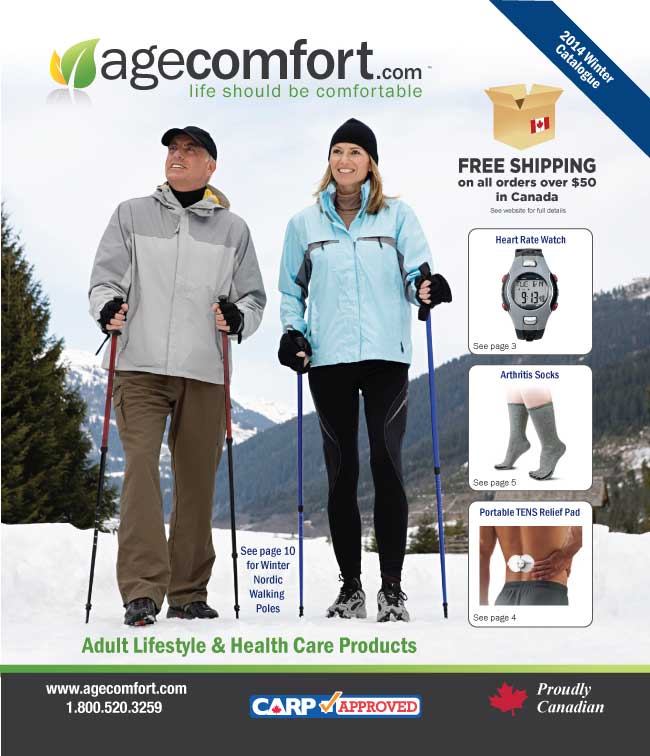
Our Winter 2014 Flyer is Out!

Our Winter 2014 flyer is out!

Brrrr.... Winter is here, and we got you covered! This flyer is packed with great aids to help you get through the winter season. Go ahead, and take a look at our winter flyer for amazing items at hot prices.

View the flyer online or request a copy by mail here

cover-page-winter-2014.jpg

Some of the great features of this new flyer include, Nordic Walking Poles, Arthritis Socks, Heart Rate Watch, Portable TENS Relief Pad, Flu Prevention MedicationsPhysical Therapy and Daily Living items, and many other products designed for a variety of people.

The Anti-Alzheimer’s Diet

Eating more olive oil, nuts, fish, poultry, and certain fruits and vegetables and limiting red meats and high-fat dairy products may help ward off Alzheimer's disease.
The Anti-Alzheimer’s Diet 
Evidence that links specific nutrients to the prevention of dementia has turned up regularly from labs around the globe. But in the real world, people don't eat nutrients, they eat food. And they eat combinations of different foods, so researchers at Columbia University Medical Center in New York analyzed the diets of more than 2,000 men and women age 65 and older in New York City to find out how eating patterns relate to dementia. 

The participants, who were free of dementia when the study began, were evaluated for signs of Alzheimer's disease every 18 months of about four years. At the same time, the researchers analyzed their diets to pinpoint foods that contained nutrients previously linked to Alzheimer's disease - such as those high in saturated fats including red meat, butter, and cream - as well as those linked to a lower risk of the disease - foods rich in "good" fats and brain-healthy vitamins such as almonds, olive oil, and oily fish. By the end of the study,253 participants had developed Alzheimer's disease. 

One eating pattern stood out as especially protective. Those least likely to be stricken with Alzheimer's consumed a combination of foods rich in brain-healthy nutrients including olive oil and vinegar, nuts, fish, poultry, vegetables like broccoli, cauliflower, and cabbage, green leafy vegetables, and fruits, including tomatoes. They also ate less red meat, butter, and high-fat dairy products. 

"The men and women who adhered most closely to this eating pattern had a 38 percent lower risk of developing Alzheimer's disease," says neurologist Nikolaos Scarmeas, M.D., one of the study's authors. "The combination of foods was most important. That's where you get the benefit."

Scarmeas cautions that it's too soon to offer firm advice about diet and Alzheimer's disease. However, research shows that nutritious foods can improve cardiovascular health and lower cancer rates. "And there are hints they may be helpful for brain disease, so it makes sense to eat them," he says. 

"This study supports what past studies have shown," says Martha Morris of the Human Nutrition Research Center on Aging at Tufts University in Boston. "The diet the authors identify as good is consistent with current recommendations."

By: AARP

Photo Credit: Wonderlane

Tuesday, January 7, 2014

Is it Safe to Leave Someone with Alzheimer's Alone?

What to consider when you loved one with Alzheimer's disease is home alone. 

alzheimers


Wandering
Will they stay at home or wander off? Is there a nearby store or coffee shop they like to visit? If you are concerned with wandering, consider double locks with a key, ID bracelets, and wandering registries. 

Do they know how to reach you and emergency assistance? 
Keeping emergency numbers such as family contact information and 911 beside each phone is an obvious and bolded format is important if anything should happen. 

Rummaging or hiding of household items
It is best to lock up all toxic and hazardous products and medications in a secure place. You may also wish to simplify the home by removing clutter and valuable items that may be hidden, lost or misplaced by a person with AD. Provide them with their own "safe box" or treasure chest to store objects.

Do they show signs of agitation, depression or withdrawal if left alone?
Being left alone may increase the stress experienced by a person with AD. Once agitated they may cause damage to themselves or the home, may leave. It may be challenging to calm them down once you return. 

Can they recognize dangerous situations? 
Can they identify signals such as smoke or fire alarms that would alert them of potential dangers? if they cannot recognize dangerous situations they may cause harm to themselves or others and are most likely unsafe to be left alone. 

Do they have frequent life-threatening health emergencies? 
Consider whether they have a history of heart attacks, strokes or seizures. Leaving them home alone, especially if it may cause them stress, may increase their risk of a health emergency. Carrying an emergency response button may help if they recognize it's use in a crisis situation.

Hallucinations, Illusions and Delusions
Due to complex changes in the brain, people with AD may see or hear things that have no basis in reality. Medical therapy and home adaptations may help to reduce their occurrence (soft lighting, clean area, familiar items). However there are serious risks to leaving them alone. 

Do they attempt to use the stove or other appliances unattended? 
You will need to evaluate the safety of leaving them home alone if they regularly attempt to use the stove, appliance, repair, woodworking tools or other former hobbies and activities. 

Do they have keys and access to a vehicle? 
Unfortunately, a person with AD loses independence, which is very frustrating. If they cannot follow the safety hazards enough to drive alone it may be best to hide the keys and remove the vehicle from sight. 

Follow-up plan
Write down Doctors and Social Workers contact information, as well as follow up appointment dates and times. Make sure you have all needed instructions for follow-up care such as rehab exercises and diet, when preparing to leave the hospital.

Home care helps
Caregivers with dementia experience are loving professionals who can assist with daily activities and provide respite for family caregivers. A variety of schedules are available and each client receives personalized attention.

By: Cindy Stead, Private Home Care Expert at AgeComfort.org Health Care Resource Centre

Tuesday, December 24, 2013

Happy Holidays!

From everyone at AgeComfort.com, we would like to wish you a comfortable holiday season and a happy new year!

Thursday, December 19, 2013

The Benefits of Nintendo Wii on Older Adults

If you had asked me ten years ago what I thought of adults playing video games, I would have responded with, "not in this lifetime." At that time, it was normal to see kids sitting in front of their televisions with handheld controllers maneuvering various characters through levels of varying degrees of difficulty.

In the fall of 2006, Nintendo introduced the Wii. Unlike gaming systems before it, the Wii had a wireless controller that could detect movement, two notable features that, at the time, was not available on any other gaming console. Nintendo's intent with the Wii was to change that way we play video games, as well as introducing video games to a wider audience. 

While still a student, we often had discussions about who would benefit from the Wii, who was more likely to play, and whether or not the older generation would catch on. Fast forward a few years later. I find myself working at a retirement community that utilizes the gaming system with their residents. The first time I had to facilitate the program, I was curious to see how they would do and who exactly would be participating. 

260px-Wii-ConsoleWhen the program began, i noticed that there was a good mix of people who had played before and would never dare miss the program, and those who had never touched a video game, but were curious to see what it was all about. The game we played for the afternoon was Wii Bowling. Interestingly, all the participants were former bowlers at one point or another, either competitively or internationally. The game accurately mimicked the movements of a person bowling to the extent that the residents who had bowled before were able to easily and quickly learn the game and how to use the controller. 

Over time, the benefits of participating in the program were clear. Residents were becoming more social with one another, often calling each other in advance to ensure their friends were coming, confidence increased as their skill level improved, and their tolerance level for activities was increasing as they wanted to play for longer and longer. 

So why exactly has the Nintendo Wii been so successful in attracting new gamers in the adult population? Interactive video games render standard video games more accessible. Participants are able to customize characters that look like them, dress like them, and the can even name them. In addition, by allowing the controller to be wireless, the participant is able to freely move about without the fear of getting tangled in the equipment. The detection of movement in the controller is an undeniable benefit, allowing the participant to directly control the video game by having the game directly mirror their movements. The participant is able to immediately see the results and consequences of how their movement affects the game. 

Elizabeth H. Weybright et al's study stated that video games have been associated with improved attention and reaction time, improvements in knowledge acquisition and retention, and significant increases in positive emotions. Video games use skill selection and cumulative levels, paired with visual graphics to increase engagement, attention and concentration. The results for the participant finishing a level or reaching a milestone goal is the feeling of achievement (Weybright, Dattilo & Rusch, 2010).

The Nintendo Wii, specifically the bowling game, offers participants both physical and cognitive stimulation that could greatly benefit the older adult population. They have made the gaming system user-friendly by eliminating multiple buttons and simplifying the controller. Physically, the game requires the use of the upper extremities, lower extremities (if standing), core stability, balance, and both gross and find motor control. Cognitively, participants must be able to attend to a task, follow directions, coordinate hand/eye movement, and be able to remember sequences, as a sequence of buttons need to be pushed on the controller to start, continue, or play the game (Weybright et al., 2010). Gaming systems have changed quickly within the last few years, and unbeknownst to me, it was only a matter of time before technology became appealing to the masses, including the older generation. 

By: Anna Luu, Recreational Therapist Expert at AgeComfort.org Health Care Resource Centre

References

Weybright, E., Dattilo, J., & Rusch, F. (2010). Effects of an interactive video game (nintendo wii) on older women with mild cognitive impairment. Therapeutic Recreation Journal, 64(4), 271-287.

Photo Credit: Wikipedia

Tuesday, December 10, 2013

8 Winter Fall Prevention Tips for Seniors

Ah, winter. Blizzards, freezing temperatures, visiting the ER because you fell on ice. For kids, winter is an exciting time. They love playing in the snow and sliding around on the ice. For senior citizens, all that ice and snow means an increased chance of slipping and falling.
Here are eight things you can do to make winter a less perilous:

1. Check you footwear. 

Examine your shoes and boots. How's the traction? Is it time for a new pair? Better traction can help keep you more stable on icy surfaces. 

2. Make sure you are equipped with a shovel and salt. 

The reason you need a shovel and salt is so you don't have to walk on a slippery sidewalk. If you have to traverse through the snow and ice to get to your garage where the salt and shovel are kept, that defeats the purpose. 

3. Check the railings. 
8 Winter Fall Prevention Tips for Seniors
If you have railings leading up to your front door, check to see if they are sturdy. If you slipped, would they be able to support you? 

4. Carry a cell phone. 

Bring a cell phone when you leave the house. If you fall, it can sometimes be hard to get p. Carrying a cell phone whenever you go out can bring peace of mind. 

5. Slow down. 

Allow extra time if it's slippery out. It's when you hurry that you end up pushing the envelope of what your balance can handle. Also, keep in mind that being a little late is better than rushing and causing a fall. 

6. Ask for help. 

If you have to walk across an icy sidewalk or parking lot, try to find a steady are to lean on. Most people are happy to help an older person navigate a slippery walkway? You just have to ask. 

7. Have a plan. 

When you are going out, ask yourself, "If I slipped and fell here, what should I do? 

8. Strengthen your legs. 

Strong leg muscles can help you steady yourself if you slip. And if you do fall, they make it a lot easier to get back up. You should exercise your legs regularly to keep them strong. Try walking up and down your stairs repeatedly or do a set of ten squats out of a chair a couple times per week. 

These little things, when used together, can make the winter elements a little less daunting. 

You can also prevent falls with better balance. Senior fitness expert Mike Ross has developed a system of balance exercises for the elderly that can be done at home with no equipment. You can find the exercises in his new book, "The Balance Manual". 


Photo Credit: Let Ideas Compete

Monday, December 2, 2013

Let the Liver Live!

Let the Liver Live!Think of your liver. It sits in the upper right area of your abdomen, protected by your rib cage. This reddish brown organ weighs about 2 kilograms and it does everything from help digest the French fries you ate last night, helps to heal the cut on your baby finger and stores that extra bit of glucose you used up running for the GO Train. It's a multi-tasker for sure.

In both Traditional Chinese Medicine (TCM), the liver, ensures energy and blood flow smoothly thoroughly the body. It also regulates bile secretion, stores blood, and is connected with the tendons, nails, and eyes.
Emotions like anger, resentment, frustration, irritability, bitterness, "flying off the handle" are also connected to the liver. 

Both TCM and ayurveda attribute liver challenges to heat that is trapped in the liver, and they seek to clear and cool the organ through lifestyle changes and herbal treatments. 

Ayurveda views the liver as "hot" or "pittic" because the fiery, dynamic energy of pitta - one of the three doshas (along with vata and kapha) that regulate the physiological functions of the body - guides and supports these myriad functions of the liver. Too much fiery energy, can accumulate in the liver and lead to physical problems. Ayurveda describes symptoms caused by excess pitta that are very similar to what is called "liver fire" in TCM: headaches; flushed face; red burning eyes; acne; nosebleeds and outbursts of anger. Ayurveda adds inflammation, allergies, and symptoms of indigestion (like heartburn) to the list. 


Live for Your Liver


Overall, both ancient wisdom and modern science agree that how we live has a huge effect on our liver. So even though you can't avoid chemical contaminants completely, you can keep your liver healthy if you just take care of it by following these 5 suggestions: 

Eat Light

Eat good-quality food when you are hungry. Avoid over eating (more liver burden) and refined or heavily processed food. 

Move your Bowels

High-fiber diets help keep the bowels, liver, and blood clean by facilitating elimination. Drink water throughout the day. And if you drink coffee or tea, add a glass of water for each. 

Take a Break

Fast on fresh juices for a day - or even just a meal - every week or two. Take time to breathe deeply, relax, and meditate. 

Cut Down on the Chemicals

Minimize exposure to chemicals of all sorts - from food additives and cosmetics to caustic cleaning agents. Remember that the liver needs to break down every chemical entering the body either for use or excretion. 

Bitter is Better

Experiment with bitter salad greens or a liver tonic like Milk Thistle for six to eight weeks. Note any changes in body, energy, or mind. 

This is a very tasty recipe that has been used traditionally for liver health:

Beet the Carrot Casserole:

1 bunch beets
1 lb carrot
2 bunches scallions chopped 
3 cloves garlic minced
4-6 tbs olive oil or ghee (clarified butter) or butter
Braggs Liquid Aminos and black pepper to taste
Grated cheddar cheese or soy cheese to taste 

Scrub beets and carrots. Steam beets whole. When half done (ten to twenty minutes) add carrots. Cook until tender yet firm. Remove beet skins. (They slid off). Grate beets and carrots with coarse grinder. Loosely (so colours stay distinct) mix them together. Saute the scallions and garlic. Toss this mixture with the beets and carrots, Braggs and black pepper. Put in casserole dish. Cover with grated cheese and bake until cheese is golden. 

Podcast: Let the Liver Live!

Photo Credit: Walmart